Baidu Unlimited OCR Explained

Baidu Unlimited OCR Explained: The Open-Source OCR Model That Can Read Entire Documents Without Breaking a Sweat
Optical Character Recognition (OCR) has evolved significantly over the past decade. We started with rule-based engines capable of extracting plain text from scanned documents, progressed to deep learning-based OCR systems that improved recognition accuracy, and eventually reached Vision Language Models (VLMs) capable of understanding layouts, tables, mathematical formulas, charts, and even handwritten content.
Despite these advancements, one major challenge has remained largely unsolved: efficiently processing long documents.
Whether it's a 200-page research paper, a legal contract, an annual financial report, or a scanned textbook, most modern OCR systems struggle as document length increases. The problem isn't always accuracy—it’s computational efficiency. As documents grow larger, inference becomes slower, GPU memory usage increases, and many systems resort to splitting documents into individual pages before processing them.
Baidu's newly released Unlimited OCR aims to solve this bottleneck with a novel architecture that rethinks how decoder attention works. Instead of relying on an ever-growing memory of generated tokens, it introduces Reference Sliding Window Attention (R-SWA), enabling efficient parsing of long documents while keeping memory usage nearly constant.
For developers building document AI applications, enterprise automation platforms, Retrieval-Augmented Generation (RAG) systems, or intelligent search solutions, this release is worth understanding.
What is Baidu Unlimited OCR?
YT courtesy : 1littlecoder
Unlimited OCR is an open-source Vision Language Model developed by Baidu for end-to-end document parsing. Unlike traditional OCR engines that focus solely on recognizing text, Unlimited OCR understands document structure and converts complex documents into structured outputs such as Markdown while preserving layouts, tables, headings, lists, and formulas.
Rather than processing documents page by page, Unlimited OCR is designed to process long documents in a single inference pass, maintaining context across multiple pages.
This architecture significantly simplifies document processing pipelines and reduces the engineering complexity required to reconstruct large documents after OCR.
Link to repo : https://github.com/baidu/Unlimited-OCR
Why Traditional OCR Struggles with Long Documents
To understand why Unlimited OCR is important, it's helpful to examine how most OCR systems operate.
Traditional OCR engines typically follow a straightforward pipeline:
PDF
↓
Convert PDF into Images
↓
Detect Text Regions
↓
Recognize Characters
↓
Merge ResultsWhile this works well for simple documents, it struggles with:
Multi-page tables
Scientific papers
Financial reports
Legal contracts
Books
Technical documentation
Modern Vision Language Models improved recognition quality but introduced another issue.
They generate text autoregressively.
This means each newly generated token depends on all previously generated tokens.
As output grows, the model must maintain an increasingly larger Key-Value (KV) cache inside GPU memory.
The result is predictable:
Higher GPU memory usage
Increased latency
Reduced throughput
Higher deployment costs
For enterprises processing thousands of documents daily, this quickly becomes expensive.
The Hidden Cost of Modern OCR
Many developers focus only on OCR accuracy.
However, production systems also care about:
GPU utilization
Response time
Memory footprint
Infrastructure cost
Concurrent request capacity
Imagine processing a 60-page legal agreement.
A conventional autoregressive decoder continuously expands its memory as new text is generated.
By the end of inference, the decoder is attending to thousands of previous tokens.
This causes inference speed to gradually decline.
Instead of solving this architectural limitation, most OCR systems simply split the document into individual pages.
Although effective, this approach sacrifices context and requires additional post-processing.
How Unlimited OCR Takes a Different Approach
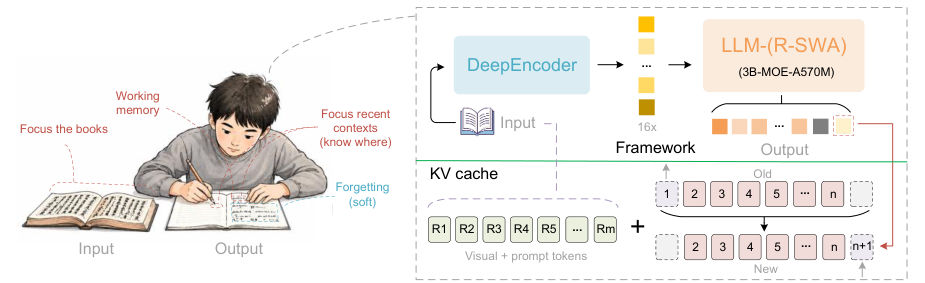
Unlimited OCR introduces Reference Sliding Window Attention (R-SWA).
Instead of attending to every generated token, the decoder always attends to three things:
Visual tokens extracted from the document
User prompt
A small sliding window of recently generated tokens
Everything outside this recent window no longer consumes expensive decoder memory.
Because the original visual information remains available throughout inference, the model doesn't need to keep the entire generated history active.
This results in an almost constant decoder memory footprint, regardless of output length.
In practical terms, the model can process significantly longer documents without the dramatic slowdown commonly observed in standard transformer decoders.
Understanding R-SWA with a Simple Example
Imagine you're copying a textbook.
You don't reread every page you've already copied before writing the next sentence.
Instead, you:
Look at the original page.
Remember only the last few words you wrote.
Continue writing.
Humans naturally rely on short-term working memory.
Unlimited OCR applies a similar principle.
Instead of remembering every generated token forever, it continuously references the original document while maintaining only a small working context.
This simple architectural change has significant implications for inference efficiency.
Architecture Overview
At a high level, Unlimited OCR follows this pipeline:
Architecture OverviewPDF / Image
│
▼
Vision Encoder
│
▼
Feature Compression
│
▼
Reference Sliding Window Decoder
│
▼
Structured Markdown OutputUnlike conventional OCR systems that repeatedly reconstruct context from generated text, Unlimited OCR continuously references the original visual representation.
This makes it particularly effective for preserving document structure across multiple pages.
Why This Matters for AI Applications
OCR is no longer just about extracting text.
Modern applications require understanding documents.
Examples include:
AI document assistants
Enterprise search
Invoice automation
Contract analysis
Healthcare documentation
Financial auditing
Academic research
Knowledge management
RAG pipelines
These systems depend on preserving relationships between sections, tables, headings, and figures.
Page-by-page OCR often breaks these relationships.
Unlimited OCR helps preserve document continuity, improving downstream AI performance.
Unlimited OCR vs Traditional OCR
Feature | Traditional OCR | Unlimited OCR |
|---|---|---|
Multi-page understanding | Limited | Yes |
Layout preservation | Basic | Advanced |
Table recognition | Moderate | Strong |
Formula recognition | Limited | Better |
Long-document efficiency | Poor | Excellent |
GPU memory scaling | Linear | Nearly constant |
Open Source | Depends | Yes |
Unlimited OCR vs DeepSeek OCR
Unlimited OCR builds upon many ideas introduced by DeepSeek OCR but focuses specifically on improving inference efficiency.
The biggest difference lies in decoder attention.
DeepSeek OCR follows conventional autoregressive decoding.
Unlimited OCR replaces this with Reference Sliding Window Attention.
Benefits include:
Reduced KV cache growth
Lower memory consumption
Better scalability
Faster inference for long documents
More efficient production deployment
Rather than improving OCR accuracy alone, Unlimited OCR addresses one of the largest engineering challenges in deploying document AI at scale.
Practical Use Cases
Unlimited OCR has applications across multiple industries.
Enterprise Document Management
Organizations processing contracts, invoices, reports, and compliance documents can reduce preprocessing complexity while maintaining document structure.
Retrieval-Augmented Generation (RAG)
High-quality OCR directly improves embeddings, search relevance, and answer quality.
Legal Technology
Large legal contracts often span hundreds of pages.
Maintaining context throughout OCR improves downstream clause extraction and semantic search.
Financial Services
Banks process annual reports, loan applications, audit documents, and statements every day.
Unlimited OCR can simplify these workflows.
Healthcare
Medical records frequently contain handwritten notes, forms, tables, and scanned documents.
Preserving layout is essential for clinical AI systems.
Limitations
Like every AI model, Unlimited OCR isn't perfect.
Some potential limitations include:
GPU requirements may still be significant.
Performance depends on document quality.
Complex handwriting remains challenging.
Very large documents may still require batching depending on hardware.
Independent benchmark validation is still limited.
As the project matures, community testing will provide a clearer understanding of real-world performance.
Why Developers Should Care
Unlimited OCR isn't simply another OCR release.
It introduces a practical architectural improvement that addresses one of the biggest bottlenecks in modern document AI.
Instead of throwing more hardware at the problem, it reduces computational overhead through a smarter attention mechanism.
For developers building AI-powered document processing systems, this could mean:
Lower infrastructure costs
Faster inference
Simpler pipelines
Better scalability
Improved user experience
As open-source document understanding continues to evolve, innovations like Reference Sliding Window Attention may influence future Vision Language Models beyond OCR.
Final Thoughts
The OCR landscape has changed dramatically over the past few years. We've moved beyond simply recognizing text to building AI systems capable of understanding entire documents.
Baidu's Unlimited OCR represents another step in that evolution.
Its biggest innovation isn't just improved recognition accuracy—it's solving the computational inefficiencies that have long limited large-scale document processing.
By introducing Reference Sliding Window Attention (R-SWA), Unlimited OCR demonstrates that architectural improvements can be just as impactful as larger models or more parameters. Instead of relying on ever-expanding memory during inference, it keeps the decoder lightweight while maintaining access to the original visual context, making long-document OCR far more practical.
For developers working on enterprise automation, document intelligence, RAG pipelines, or AI-powered search, this approach offers a glimpse into the future of scalable document understanding. While independent benchmarks and wider community adoption will ultimately determine its long-term impact, Unlimited OCR is already an exciting contribution to the open-source AI ecosystem.
If you're experimenting with local AI models or building applications that rely on processing large PDFs, research papers, invoices, contracts, or technical manuals, Unlimited OCR is definitely a project worth exploring. It doesn't just promise better OCR, it proposes a smarter way to think about document parsing altogether.
Also Read : Google AI Edge Gallery: Run AI Models Offline on Your Device