

In the fast moving world of AI driven development, most updates do not fundamentally change workflows. Google Stitch is an exception. Its latest upgrade introduces a set of capabilities that shift UI creation from manual design to intelligent collaboration.
This is no longer just a tool that generates screens. It is evolving into a system that understands intent, maintains design consistency, and helps teams move from idea to production faster than ever.
What is Google Stitch
Google Stitch is an AI powered interface generation tool from Google Labs that converts text prompts, sketches, and references into fully designed UI screens along with frontend code.
Instead of following the traditional process of wireframing, designing, and then coding, Stitch compresses everything into a single workflow where users describe what they want and the system builds it.
Built on Gemini models, Stitch combines natural language understanding with design intelligence to generate structured and usable interfaces in seconds.
The Crux of the New Update
The latest update introduces five core capabilities that redefine how teams approach design and development.
From wireframes to vibe design
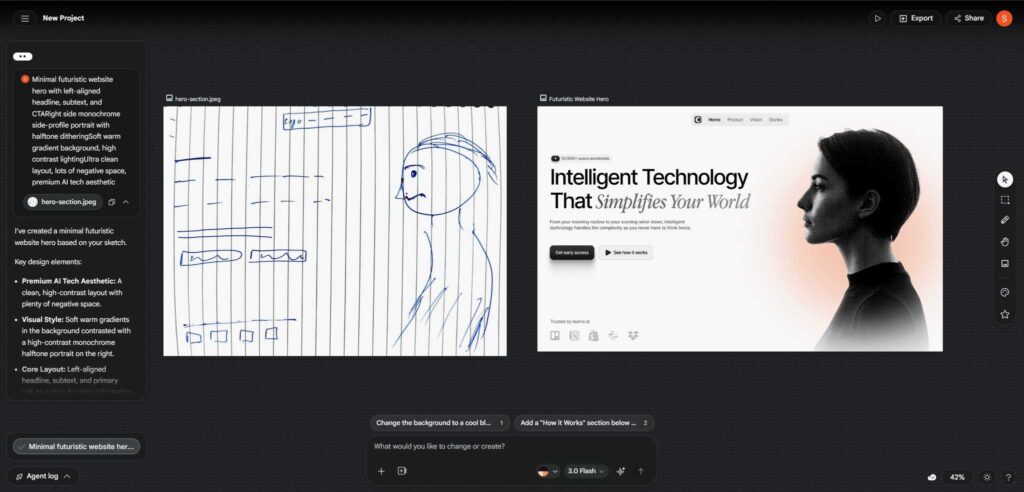
Stitch replaces rigid design workflows with intent driven creation. Instead of starting with blank canvases or grid systems, users can describe business goals, product intent, or even the emotional tone of the interface.
You can provide inputs like inspiration links or describe the desired feel such as clean, modern, or premium. The AI interprets these signals and generates high fidelity UI options instantly.
AI native infinite canvas and design agent
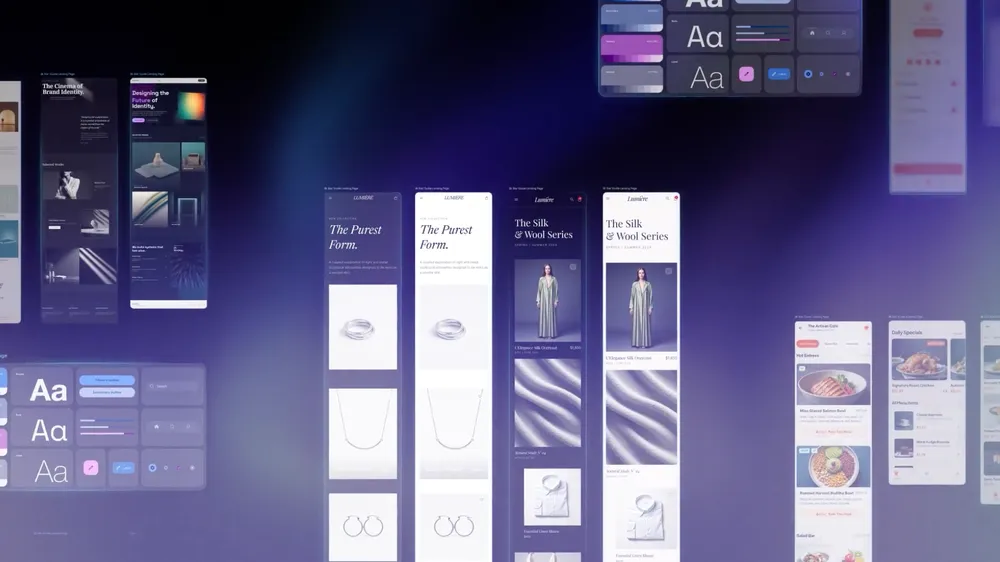
The workspace is now an infinite canvas that supports text, visuals, and code as contextual input. This allows teams to explore multiple ideas without constraints.
A dedicated design agent understands the full project context and maintains consistency across screens. Alongside it, an agent manager enables users to explore multiple design directions in parallel without losing progress.
Portable design systems with DESIGN.md
Consistency has always been a challenge in fast moving projects. Stitch introduces DESIGN.md, a structured markdown format designed for AI systems.
This allows users to extract design rules from existing products or reuse styles across projects. Teams can export and import design systems without rebuilding everything from scratch, making workflows faster and more scalable.
Voice driven iteration and critique
The update introduces voice as a primary interaction layer. Users can now speak to Stitch to refine designs in real time.
The AI acts as a creative collaborator by offering suggestions, generating layouts through conversational input, and applying instant changes such as modifying themes, layouts, or visual styles based on spoken feedback.
Seamless design to code workflow
One of the most important improvements is the tighter integration between design and development.
Using Model Context Protocol and supporting SDKs, Stitch allows high fidelity designs to be exported directly into development environments such as Google AI Studio and Antigravity. This reduces the gap between prototype and production and enables faster implementation.
Why This Update Matters
These changes position Stitch as more than a design tool. It becomes a system that actively participates in building products.
Faster product development
Teams can move from concept to working interface in minutes instead of days.
Unified workflows
The gap between design and development is reduced, minimizing back and forth between teams.
Better consistency at scale
With reusable design systems and contextual understanding, products maintain a consistent look and feel across screens.
Accessibility for all creators
Even users without design expertise can create polished interfaces using natural language or voice.
Real World Use Cases
Startup MVP development
Founders can rapidly generate product interfaces without relying on large design teams.
Rapid experimentation
Teams can explore multiple UI directions simultaneously and select the best one.
Developer acceleration
Frontend developers can use generated code as a starting point and focus on business logic.
Design system scaling
Organizations can standardize and reuse design patterns across multiple projects efficiently.
Current Limitations
Stitch is still evolving and has some constraints.
It offers limited interactivity in generated interfaces and relies heavily on the quality of input prompts. It is not yet ideal for highly complex or deeply customized design systems.
At present, it works best as a powerful starting point rather than a complete replacement for traditional tools.
The Bigger Picture
Google Stitch reflects a broader shift in software development where AI is taking ownership of both design and frontend layers.
From generating code to building interfaces, AI tools are reducing the need for manual effort and enabling faster product creation. This indicates a future where developers and designers focus more on intent and outcomes rather than implementation details.
Final Thoughts
With its latest update, Google Stitch moves closer to becoming a central tool in modern product development.
The introduction of vibe driven design, infinite canvas, design agents, reusable systems, and direct code integration shows a clear direction toward conversational and intent based creation.
If this momentum continues, the process of building digital products will become significantly faster, more accessible, and less dependent on traditional workflows.
Also Read : China NeuraLink Moment, Built brain chip without any surgery